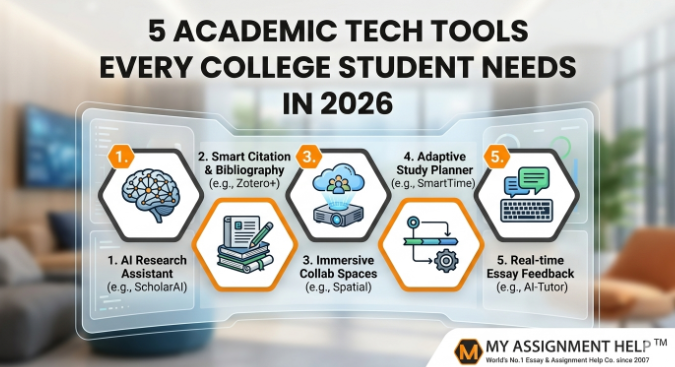
The landscape of higher education across the United States has undergone a tectonic shift over the last few years. By 2026, the traditional methods of note-taking, rote memorization, and manual data calculations have been firmly replaced by hyper-efficient, cloud-native, and computationally advanced software systems. With institutional data from the National Center for Education Statistics (NCES) indicating that over 72% of modern undergraduate courses incorporate specialized software systems into their baseline curriculums, academic survival is no longer just about working hard—it is about optimizing your digital workspace.
For undergraduate and postgraduate students attempting to balance heavy course loads, part-time professional roles, and intensive field research, the mental fatigue can quickly become a bottleneck. When deadlines stack up simultaneously, the pressure often prompts students to search for specialized academic assistance, leading many to ask, “Who can do my r assignment with precision?” In these highly demanding scenarios, leaning on a premium, long-standing academic platform like myassignmenthelp provides the precise technical support required to manage severe academic stress, allowing students to systematically master complex analytics without compromising their overall GPA or well-being.
💡 Key Takeaways: The 2026 Academic Efficiency Roadmap
- Technical Adaptation: Proficiency in advanced computation, semantic indexing, and automated citation architectures is now a basic requirement for academic survival.
- Strategic Delegation: Utilizing trusted educational resources to bridge skills gaps in programming or literature reviews is a vital part of maintaining a competitive academic edge.
- Strategic Toolkit: Integrating specialized software ecosystems allows students to reclaim up to 15 hours per week of manual formatting and data manipulation time.
The Evolution of the Academic Tech Ecosystem
We have moved far beyond basic cloud document processors and generic spellcheckers. The modern American lecture hall requires tools that synthesize information, process advanced statistical packages instantly, and ensure that academic integrity is built into the workflow from day one. Below, we review the top five non-negotiable tech tools that every college student must deploy to stay competitive, accurate, and organized this academic year.
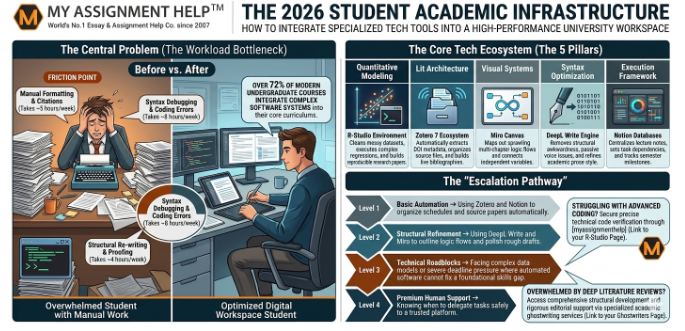
📊 Visual Blueprint: The 2026 Student Academic Infrastructure
A comprehensive framework detailing the integration of core technologies into a modern undergraduate workspace:
| Core Application Space | Primary Software Tool | 2026 Academic Impact Factor |
| Advanced Quantitative Analytics | R-Studio / Posit | Critical for Econometrics, Biostatistics, and STEM research pathways. |
| Automated Bibliography & Schema | Zotero 7 Ecosystem | Eliminates manual formatting risks across APA 7th, Harvard, and IEEE styles. |
| Comprehensive Research Structuring | Miro Interactive Workspace | Crucial for mapping dissertations and complex multi-chapter logic flows. |
| Prose & Clarity Refinement | DeepL Write Engine | Ensures clean syntax and clear articulation for academic manuscripts. |
| Unified Dashboarding | Notion Dynamic Databases | Tracks task dependencies and resource allocation across multiple semesters. |
1. R-Studio: The Undisputed King of Quantitative and Statistical Analysis
Whether you are pursuing a degree in Econometrics, Data Science, Biostatistics, or even Behavioral Psychology, empirical data modeling is an absolute requirement. Gone are the days when static Microsoft Excel spreadsheets were sufficient for higher-level university research. Today, academic institutions utilize R-Studio—an integrated development environment (IDE) for the R programming language—to run complex regression calculations, structural equations, and high-fidelity data visualizations.
According to research published by the American Statistical Association (ASA), university syllabi requiring R programming have increased by 44% over the past three years. R-Studio enables students to clean messy real-world datasets, generate reproducible research documents via RMarkdown, and perform predictive analytics that mirror corporate workflows.
2. Zotero 7: Next-Generation Semantic Citation and Reference Management
Writing a comprehensive research paper, thesis, or dissertation involves navigating a mountain of academic literature. Manually tracking your source materials, organizing PDF files, and building bibliographies is incredibly inefficient. Zotero 7 has revolutionized reference management by introducing advanced semantic indexing and automated metadata parsing.
When you save an academic paper from Google Scholar, JSTOR, or PubMed, Zotero doesn’t just download a static file. It instantly extracts the DOI, author profile, publication date, and complete publisher metadata, while automatically generating a clean citation. Its standout feature is its seamless integration with modern word processors like Google Docs and Microsoft Word, which inserts dynamic references that adjust themselves as you move text around. Furthermore, Zotero’s cloud synchronization allows you to seamlessly share reference folders with group project members, making it an indispensable collaborative asset for modern peer-reviewed coursework.
3. Miro: Interactive Workspace for Complex Dissertation Mapping
Before putting pen to paper on any major essay or research proposal, you must visually map out your ideas. Miro has become a favorite tool among college students who need to organize sprawling literature reviews or map out multi-chapter arguments. It functions as an infinite, cloud-based whiteboard that lets you map out your entire thesis structure visually.
Using customizable canvas frameworks, you can visually organize qualitative data, link independent variables to dependent variables, and structure your arguments before typing your first draft. This level of visual organization is particularly helpful for visual learners who feel overwhelmed by dense text files. By laying out your sources, arguments, counter-arguments, and transitional elements on a single, zoomable canvas, you ensure your final document follows a clear, logical progression.
4. DeepL Write: Elevating Academic Prose and Structural Clarity
While generic grammar checkers focus on simple punctuation and spelling rules, DeepL Write provides highly advanced, nuance-aware prose refinement specifically optimized for academic writing. Built on sophisticated neural networks, this platform helps students elevate their working drafts into polished, publication-ready academic manuscripts.
DeepL Write excels at identifying structural awkwardness, passive voice issues, and poor word choice without altering the author’s original meaning or voice. It provides real-world stylistic alternatives that improve the overall clarity, conciseness, and academic tone of your work. This tool is especially helpful for international students navigating ESL challenges, or anyone looking to ensure their research arguments are presented with maximum professional impact.
However, when a student is dealing with a severe time crunch or trying to manage complex interdisciplinary theories, software tools alone might not be enough. In these high-stakes situations, utilizing premium academic ghostwriting services can be an excellent strategic move. Getting expert structural development, thorough literature reviews, and rigorous editorial support helps students balance intensive research requirements with their personal and professional commitments, ensuring every submission meets strict scholarly standards.
5. Notion: The Ultimate Unified Command Center for Academic Life
Organizational failure is often the primary driver of academic anxiety. College life requires managing a complex web of assignment due dates, lecture notes, exam schedules, and group milestones. Notion serves as a highly customizable, unified command center that lets you track all of these components across a single digital dashboard.
By leveraging advanced database features, relation properties, and automated reminders, you can build a comprehensive semester tracking system. You can connect your class notes database directly to your assignment schedule, create custom kanban boards for tracking group projects, and use time-blocking frameworks to plan out your weekly study sessions. Keeping your data centralized in a single workspace ensures you never miss a deadline or lose track of important lecture insights.
The Ethical Spectrum of Academic Support Systems
As academic tech tools become increasingly powerful, understanding the boundaries of ethical software use is vital. Modern educational platforms are designed to enhance your understanding and streamline your workflow, not replace the hard work of learning. Using reference managers to automate your citations, relying on visual whiteboards to map out your arguments, and leveraging advanced calculation engines to verify your statistical models are excellent ways to build competitive professional skills. The ultimate goal of your academic tech stack is to eliminate tedious, manual formatting tasks, giving you more time to focus on deep analysis, critical thinking, and genuine subject mastery.
🙋 Frequently Asked Questions (FAQ)
Q1: Are these digital tools allowed under standard university honor codes across the US?
A: Absolutely. Reference managers like Zotero, organization systems like Notion, and visual whiteboards like Miro are actively recommended by major university libraries, including Harvard and Stanford, to support structured research and academic efficiency.
Q2: How does R-Studio compare to tools like SPSS or SAS in modern college courses?
A: While SPSS is still used in some social science programs, R-Studio is overwhelmingly preferred by modern data science, business analytics, and STEM departments because it is completely open-source, highly versatile, and used extensively in the corporate world.
Q3: Can these software platforms be used offline during field research?
A: Yes. Desktop applications like Zotero, R-Studio, and Notion provide robust offline functionalities, allowing you to save your changes and data locally before syncing them back to the cloud once you reconnect to the internet.
✍️ About the Author
Dr. Evelyn Vance is a senior learning design researcher and regular contributor at myassignmenthelp, specializing in academic technology integration and quantitative data methodologies. She holds a Ph.D. in Instructional Technology from the University of Texas at Austin and has spent over a decade advising undergraduate and postgraduate students across the United States on how to optimize their research workflows, build balanced study habits, and master advanced data analytics environments.
📚 References & Verified Data Sources
- National Center for Education Statistics (NCES). Technology Integration and Digital Infrastructure Trends in US Higher Education Frameworks. [nces.ed.gov]
- American Statistical Association (ASA). The Shift to Reproducible Statistical Computing Environments in Modern University Syllabi. [amstat.org]
- Harvard University Library Research Guides. Strategic Reference Management and Citation Systems for Advanced Graduate Research. [library.harvard.edu]


